You gotta give it up for Puccini. It is easy to criticize the idiotic plots and even the narrowness of his lane, but it is far easier to fall in love with his music, at once light and saucy. I cannot be the only one for whom Puccini opened the gate to opera. My gateway-drug experience will never leave my memory: December 2014, back home on break from cold New Jersey, warm in the sun but stuck in L.A. traffic, stuck in my grandma’s Corolla whose windows didn’t quite close, 91.5 KUSC classical radio outblasting the growl of the start-and-stop 5, and on it came: “un bel di” from Madame Butterfly. It was as if the sea of cars parted then through the part slammed a lightning bolt into my chest. I died and then floated above the asphalt, a young man changed, more tender now, hungry for sugar instead of the endless doses of bitter modernism I had sought since teenaged angst had first gripped me seven years before. In that same moment the motivating force of jealousy infected me too; I wanted to write my own opera and indeed I would dedicate hours and hours intermittently for the next four-and-a-half years until the curtain rose in February 2019. Puccini lit the spark.
How much of that is his harmony? A lot. Puccini occupied a fertile spot historically: in the second half of the nineteenth century, Mozart’s luminous opera style had been long canonized and had soaked into every composer’s bones; Verdi had reshaped Italian opera to brood more, reach further, and bang harder and more romantically; and to the North, Wagner had stretched the operatic form to its limits, not least using the gooey force of harmony. Puccini was young enough not to be seen as a direct contemporary competitor to those last two Romantic masters but, looking back from a twentieth century perspective, he was old enough not to have to grapple with acerbic modernism. In particular, in 1900, when Tosca premiered, there was nothing yet shameful about writing shamelessly tonal music. Tosca features some of the best.
The prudent thing to do by means of introduction would be to summarize the plot and characters leading up to the aria containing my chosen gem of a chord. I will not do that because it’s all too stupid. Instead we parachute into Act III, Scene 2, where Puccini, after recapping a couple bombastic motifs, slides through a lazy chromatic sequence to set up a spare, floating moment in B minor. The dolcissimo, vagamente, rubando melody is well-taken by a clarinet before the tenor enters.
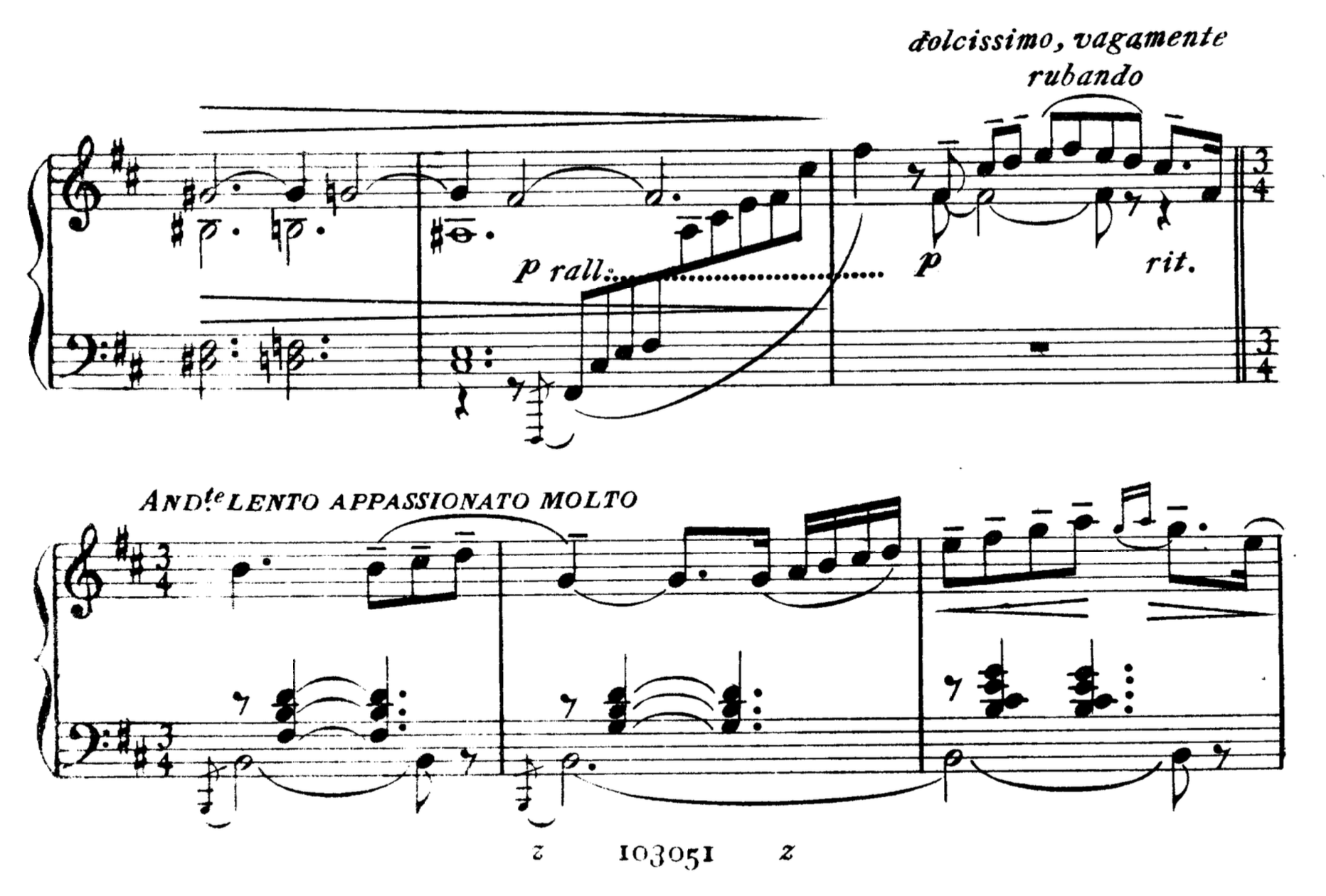
The gentle rising melody sits atop a languid chord progression over a B pedal. The chords’ purpose is nothing but to decorate the tonic and set the stage for the tenor, who, for the first iteration of this little couplet, basically talks static pitches; the orchestra is the melodic engine this first time, but then for the second pass the tenor will lead and express the melody. Let’s crank up the heat and jump to that second iteration, con grande sentimento.
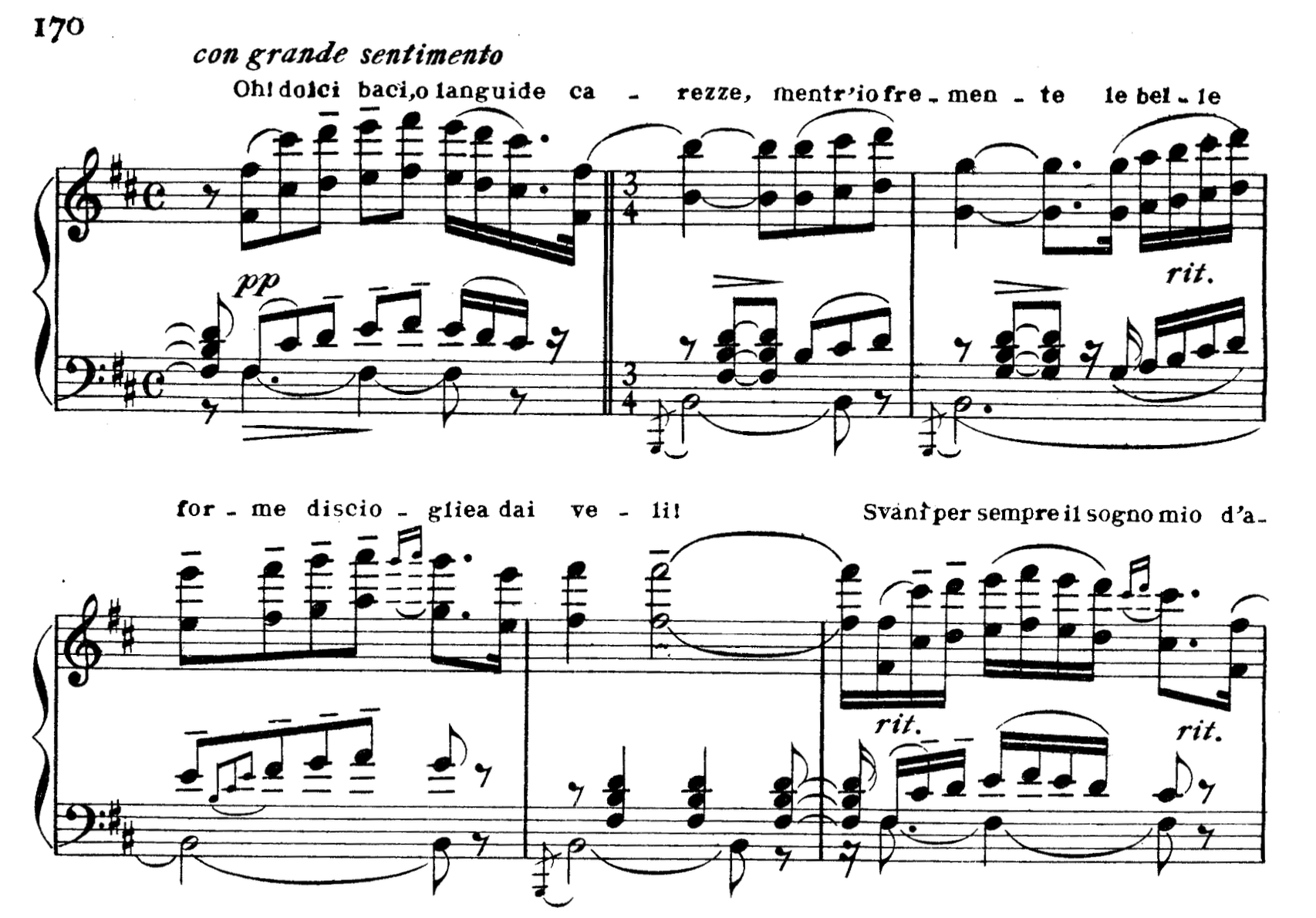
“Oh, sweet kisses and languid caresses,” — OK, OK, we get it. From the cold harmony-analyst’s lens, we are doing nothing but circling B minor still. The five-bar phrase brings us to a new line, which starts as before: B minor, then a G major triad with B lingering in the bass, but then, finally, the bass moves, converting potential energy to kinetic, triggering an even higher level of emotion.
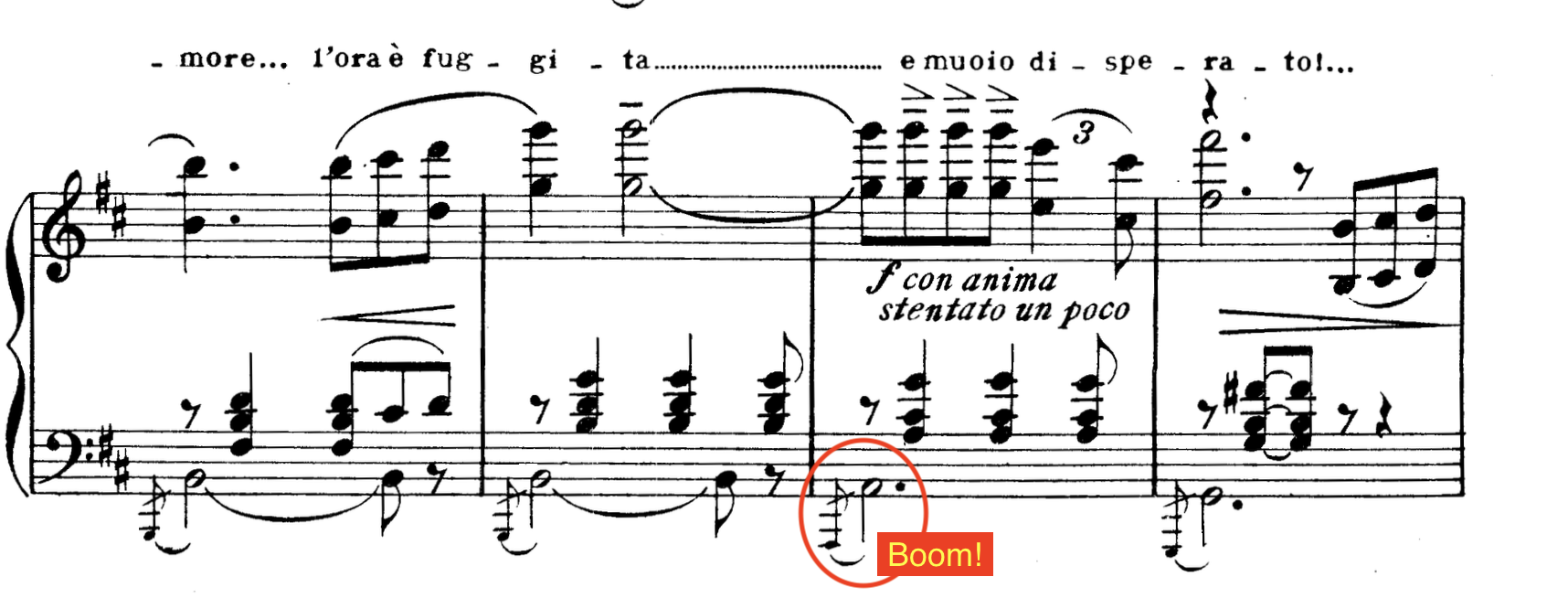
The release of the bass to A rather than B just feels so good, and its punctuation by a little hit of a drum shows us how Puccini is so in touch with romantic pacing, breathlessness contrasted with full-hearted drippy passion. The A hits, harmonized as the root of a dominant-seventh. In that moment, we are left wondering what happens next, compounding the excitement and tension of the held melody note. Does A7 prepare D major? Or does linear logic take over — as B falls to A, does A fall to G? Or G♯? Option two: G major-seven under the word “disperato” — “despair” — of course; a D major resolution would not fit at all; the dissonance between melody and bass keeps the heart’s flame burning.
We just got G in the melody over A in the bass, then F♯ in the melody over G in the bass. Indeed the next phrase of the melody emphasizes E, but Puccini delays the expected F♯ in the bass, V in B minor, by interleaving iiø7, C♯ half-diminished. He is hitting the brakes, or in Schenkerian terms, prolonging the function for which our ears pine, which mirrors the repeated text, “e muoio disperato” — “and I die in despair.” Up next is the great chord for today, as always made great by its surrounding context.
Think about what should or what could come next. Two logics are competing in this phrase: circle-of-fifths tonal logic and scalewise-descending linear logic. Puccini has to finish the word “disperato” on the note D — does he allow the F♯7 to resolve, despairingly, to B minor, or does he hit the brakes again? And what would hitting the brakes mean here? What would you do? Look on to reveal the perfect answer.
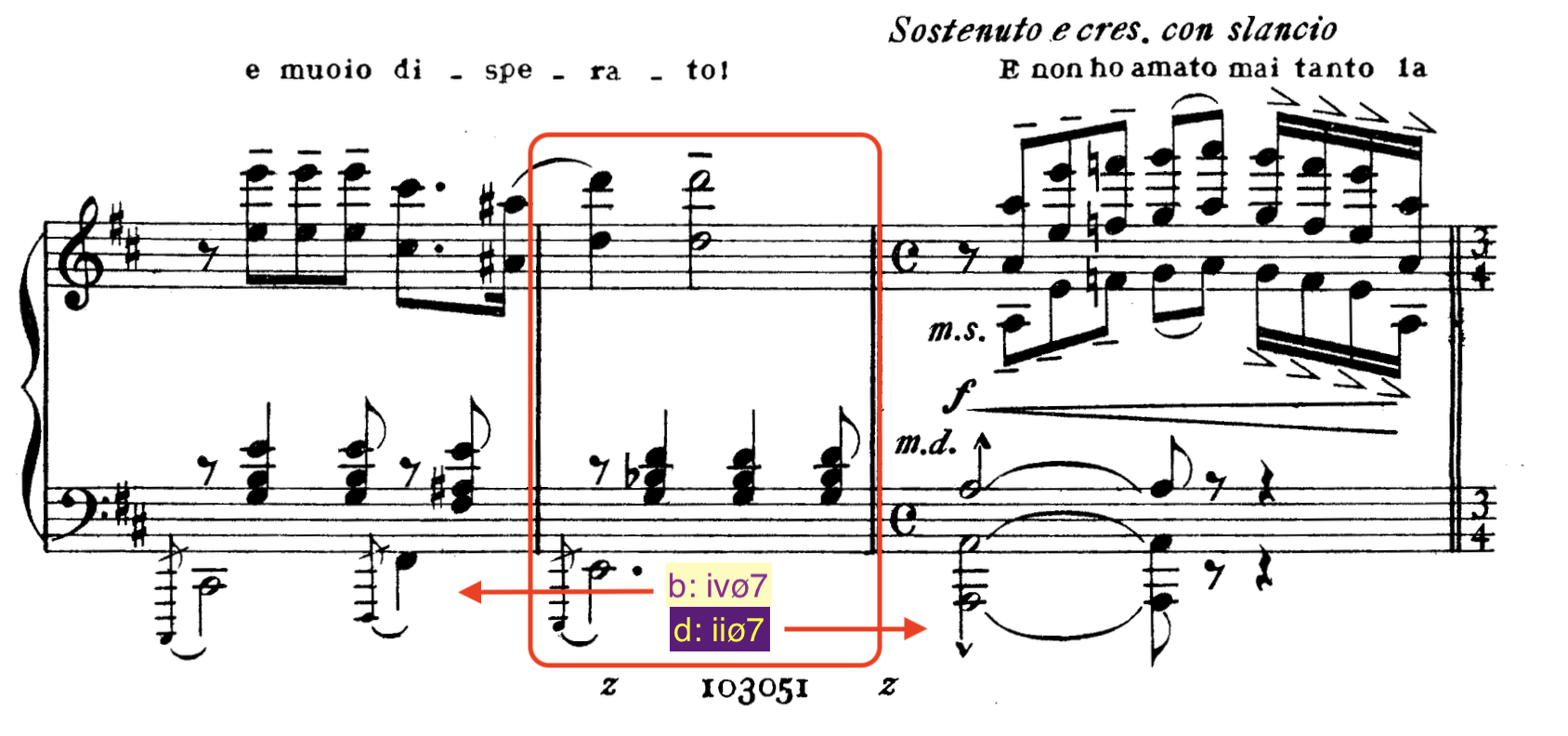
Option two again — the phrase is not yet out of energy; a cadence back to B minor would be premature. D in the melody is harmonized with E half-diminished 7. Yeeowch! The parallel stepwise sink of the melody and bass conjures a deflated, indeed despairing emotion, and this particular choice creates a tragic cross-relation of A♯ in F♯ 7 to B♭ in E half-diminished 7. I feel the floor falling out from under me here. And then, twisting the logic once again, this time from linear stepwise to tonal fifthwise, Puccini launches off Eø7 to a naked A in the bass underneath a melody outlining D minor, revealing the E half-diminished as a pivot chord. Is this a true modulation? Take a look.
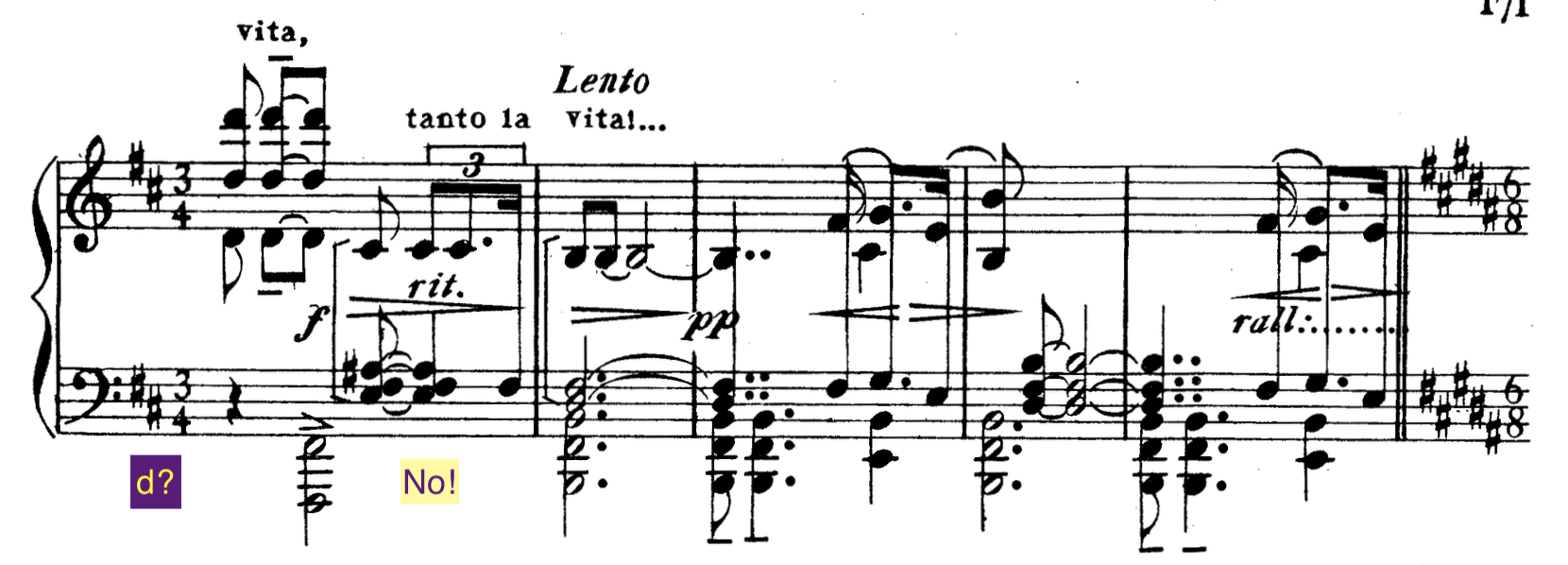
Not even close. The melody at the end of the last line screams “D minor” but the “chord” underneath it is just a solitary A, not the full A7 one might expect. Likewise, when the melody lands on that ultimate D at the beginning of this line, no chord supports it — it was a fakeout all along! Tragic! A gasping beat of silence and then F♯ 7, with the D lingering in the air, creating the pungent memory-specter of an augmented dominant chord, clashing with the reality of the C♯ below. Puccini squeezes a few bars’ worth of juice from B minor before reversing the key-signature-change in the transition to the next scene, adding on three sharps rather than three flats. The aria, so powerful in spite of its brevity, is over.
Ahh — wipe your tears and refasten the chinstrap on your analyst’s hat. A pivot chord is nothing new, not all that special; nor is a half-diminished chord at a moment of high tension and emotion. So why does this moment rock so hard and what lesson can we draw from it? I alluded to it before with the “hit the brakes” metaphor. Tonal harmony, even at its most sophisticated, is rather finite and discrete in its pathways, and even an untalented student can cobble together a lovely sequence of chords without too much training. What separates a master composer is not the chords themselves, the order in which they come, nor even the voice leadings between them; a master composer controls momentum — gas and brakes. In this example of Puccini, the mastery lies in his negotiation of two forces, stepwise versus fifthwise motion, the way he leads us and baits us, building both expectation and bewilderment so that the gut-punch chord comes as a shock that nonetheless coheres with the flow of chords surrounding it. To see what I mean, consider any example of the vast number of more pedestrian choices he could have made from, say, the A7 that sets of the necessity of tonal motion after the stretch of B minor and B-minor-adjacent chords over the pedal. The A7 could have gone to D, closing off the motion before it had a chance to get going. The G∆7 could have fallen straight to F♯7, or some 6/4–5/3 move, without the little C♯ø7 feint. The Eø7 might have been just B minor, or something a little sadder, but not as downright tragic, like E–7, and then even if Puccini had landed on Eø7, he could have been tempted to follow it more wholeheartedly to D minor. His choice instead to merely hint at D minor over exposed bass notes, then twist right back to B minor, is a choice made with great restraint that unlocks great tragedy, suited for a man who is speaking of his life as if it has already passed. Gas and brakes, applied just so.