We love Tchaikovsky. He does not hide from you when you listen. He plays to his own strengths, most of all his talent for melody — quite possibly the supremest of all time. Another plus: one hears an overflowing love for Mozart in Tchaikovsky and one dares not disagree with that love. Tchaikovsky’s conservatism and his skew towards foreground make him sound a little older than he really is; he was born in 1840 — Schubert and Beethoven, two of the few composers whose loves of Mozart matched Tchaikovsky’s, had been dead more than a decade! Tchaikovsky himself died in 1893, by which time Mahler had already hit the scene, giving the second big performance of his first big symphony that year. I have to remind myself that those two men were contemporaries! Tchaikovsky, outside of the self-conscious German-speaking world, confident in his own talents, and possibly premonishing his own demise, wrote his sixth and final symphony that year, 1893, conducting the premiere a week and a half before he died. It is his best symphony. The form is a little unusual, and there is something progressive and modern about its whimper of an ending, but compared to what else was happening in '93, it is as approachable and glittering as one would expect from the maestro. It is carried on the energy of its repeating tunes, all of which stick in the ear.
But a tune, no matter how strong, yearns for support in harmony. The strongest tunes often imply their own harmony but a subtle composer chooses whether or not to indulge that implication. Harmony can illuminate a melody but it may also cloud it or refract some light on the way to your ear’s eye. More often than not, Tchaikovsky does not cloud his melodies; he respects them for the perfect gems they are. But every once in a while his Russian soul lets the darkness in, and those of us with Russian souls cackle through our tears when he does. It is from this sixth, pathétique, symphony, where a most pungent and beautiful of these moments comes.
The symphony opens with a slow, mysterious, wrong-key (but how could you know?) episode followed by a sharper allegro that rises and rises, lots of staccato, lots of diminished chords surrounding tonal destinations in B-minor’s orbit. After a couple minutes, however, the engine starts to lose steam, seemingly early. The orchestra sinks down in register and gets caught in a looping figure that flattens out: sixteenths to triplets to eigths, then wisping away in a final — pathétique indeed — ascent. The music stops.
Tchaikovsky resumes, having delayed long enough the tenderness for which he is so well known. The E-minor red herring of the opening: gone. The B-minor fervor that rose to C♯-minor, then D♯-minor, then F♯-minor: gone. You knew it was coming: D major. Andante, tenderly, singing expansively:
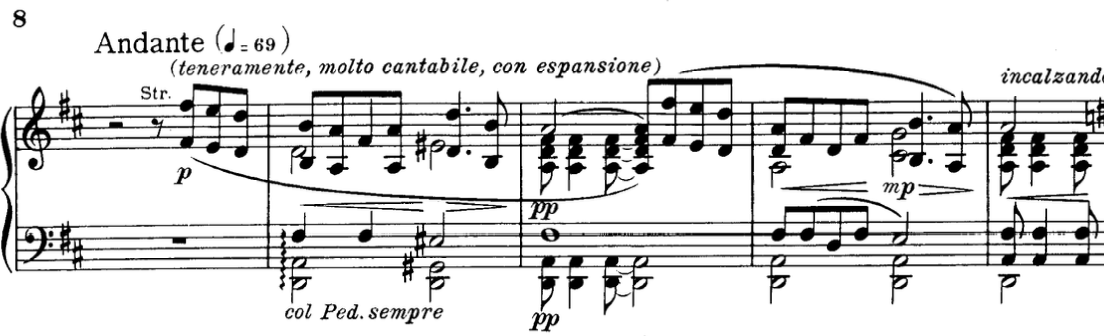
The common-tone-diminished chord halfway through the second bar hardly disrupts the purity of this statement and even the V7 chord at the end of the fourth sits over a tonic pedal, as if Tchaikovsky is half-hearted about the motion. It’s beautiful, if not elementary, which does not make it any less beautiful.
The next phrase therefore has to introduce some strife. The melody rockets up an octave so that it can tiptoe its way back down. The D pedal remains in the bass. The harmony gives a little kinetic energy but nothing crazy: D♯ diminished to E minor, with a 9-8 suspension in the melody; then C♯ dininished to D major, with the same suspension. Lovely — just the right amount of contrast with the preceding phrase, a little tension that then relaxes.
So what’s next? One could make a number of choices but Tchaikovsky makes the best of all. He punches you in the gut.
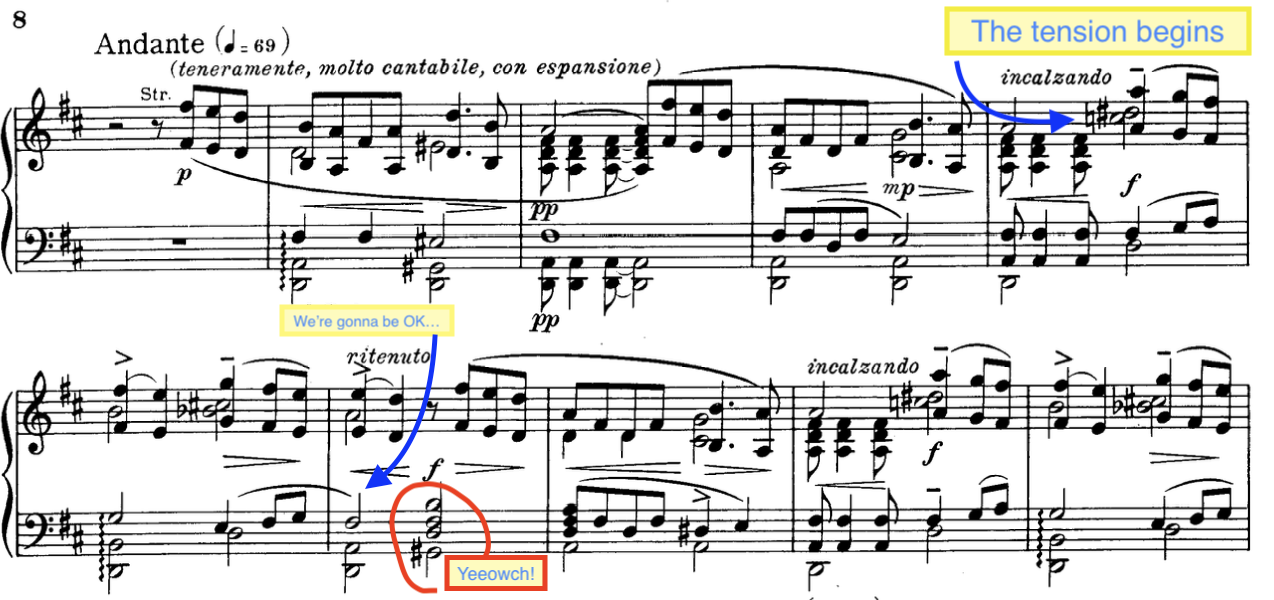
G♯ half-dimished! Oof! And what a composition lesson in this moment! That chord is pungent on its own, and we will soon discuss why, but Tchaikovsky intensifies its sourness with both orchestration and melody. This is where the D pedal ceases to be. He pulls the ground from under you. Oof! And what’s the melody when that chord lands? None at all! Oof! An eighth rest of genius exposes the tangy chord in clarinets, horns, and bassoon.
Nor does he overdo it. The chord goes where it should — to A, which brings us back to D a bar later. As such, the G♯ half-dimished stands out in the sentence like a loud comma. Tchaikovsky, being Tchaikovsky, repeats the phrase straightaway and then many times later on. You come to expect it and yet it takes your breath away every time. Gorgeous. Painful. Pathétique.
Let’s break down how and why and then consider how to bottle this effect for our own purposes. (If it was good enough for Sonny Rollins, it’s good enough for us, and it was — he recorded this moment of this movement in 1957, the only Classical music he ever played, I think. If Bird is Mozart and Coltrane is Beethoven, Sonny is Tchaikovsky, right? At least for the first half of his career?)
In D major, G♯ half-diminished is ♯IV half-diminished. That is a non-diatonic chord. From where does it come? There are two straightforward candidates: it could be ii half-diminished of iii; or vii half-diminished of V. Look ahead in the music to differentiate these. Here, what comes next is an A chord: a standard cadential 6-4 setting up A7 returning to D. OK — we are preparing A. But that’s not the whole story. That doesn’t tell us why this chord hits so hard, nor does it tell us why it is such an inspired and perfect choice versus other chords that would have prepared the same cadence, like the spikier G♯ (full) diminished-seventh, or B minor for something softer, or E7 for some brightness.
Here is my attempt to answer those questions.
The chord hits so hard because it is placed in such a strong location relative to its secondary function — boom, right on a strong beat. This compounds the effect of the dropped bass pedal and the gasp in the melody. I have to admit I had always heard this special chord as landing on beat one — never counted carefully enough — and was surprised to see that it is written as beat three (which admittedly isn’t so different). If you start counting the string melody of the whole andante section as starting on the and of one rather than the and of three, you get what I’m talking about. Alternatively, you could introduce a 2/4 measure and re-bar the phrase something like this:
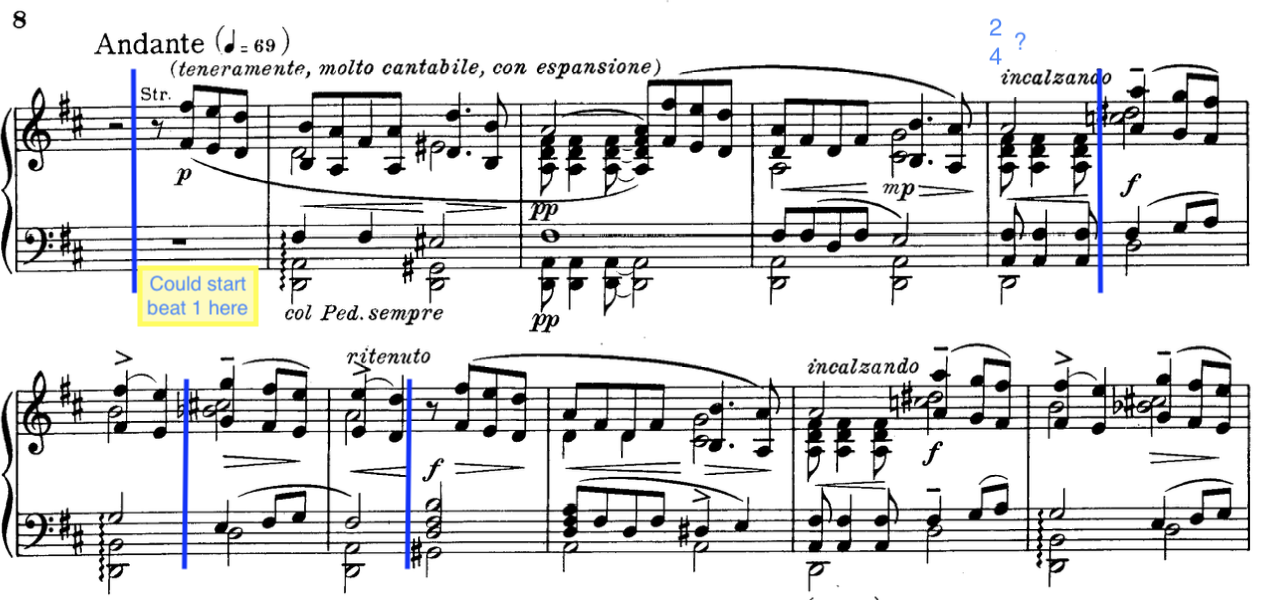
Either way, that G♯ chord lands in a strong metric location. This is unusual for a vii half-diminished chord, which is already so overshadowed by its cousins V7 and vii diminished seventh. I scanned Mozart for a half-diminished chord preparing a V chord like this and found an example so much gentler and more fleeting:

The C♯ half-diminished chord, if it exists at all, lasts just a single beat, the last of the measure, and relies on the memory of the E from earlier in the bar. It is not nearly as a proud a usage as Tchaikovsky’s. (Incidentally, I suspect that this Mozart sonata, number 5 in G, was Tchaikovsky’s favorite.) In the rest of my Mozart-scanning I found tons of diminished sevenths and tons of dominants but no other moments that matched this pattern, and this single example is itself so meager, showing how boldly Tchaikovsky is breaking a Classical norm (120 years later, yes, but still!).
The particular pathos of the ♯ iv half-diminished comes moreover from its melodic affordances, namely its support of the tonic and third of the home key, which none of its four-note alternates support. This is what I like best about this chord: as dissonant as it is, it can sit under two important, generally-stable melody notes, which is the perfect recipe for the “refracted light” effect that makes so many special chords so special. It’s the formula Tchaikovsky uses here, too. The chord lands and the melody breathes for half a beat but then enters on F♯ and descends to D — the same melody of the opening phrase, whose entire purpose is to express D major, D major, D major! These notes get recontextualized — “wait, something’s wrong…” — which makes their re-recontexualization back to their normal resonance that much sweeter.
Amazing work by Tchaikovsky, as expected. In the architecture of this little episode, he juggled a number of forces and found a chessmaster’s brilliancy that gives us everything. Let’s sum up all the strategy surrounding this chord.
- The episode, a new, slower tempo in the relative major key, begins with a placid, uncomplicated phrase that does nothing but instantiates the new local tonic of D. The melody is square as can be except for the one eighth rest it begins with.
- The consequent phrase triggers a scalar descending melody propelled by a couple of standard diminished chords that resolve in the expected ways.
- The first phrase melody returns but its single rest is filled with the pungent, inspiried G♯ half-diminished, right on a strong beat, in winds, recasting the diatonic melody in an uncomfortable light.
- Instead of overplaying his hand, Tchaikovsky lets the tonal logic take its course from there, following the special chord with a not-as-special cadence. As a result, one moment — that sour, greenish chord — stands out in this idea each time it returns.
Brilliant! Delicious!
Now, if you share my temperament you might start to notice that a lot of your favorite chords are half-diminished chords. What can I say (on your behalf)? It’s a succulent intervallic structure. I will write about some other top-notch half-diminished chords (living list: Tristan Chord) elsewhere in detail. But to wrap up now, I list a few that aren’t quite at the level of this Tchaikovsky gem but are tasty enough to mention, from the realm of jazz:
- Some versions of the standard I Should Care pull a fakeout at the top of the second half of the melody. The song opens with a I, IV, iii, VI move — nothing unusual for jazz. The first three notes of the melody are simply the tonic triad, 1-3-5. So of course I is the right chord! But 16 bars later when the second half begins, the fakeout: ♯ iv half-diminished instead of I. Tragic and beautiful! This works for the diatonic melodic reason I mentioned before: 1 and 3 in the tonic triad sit right in that chord. Unlike Tchaikovsky’s usage, though, this chord does not set up V; instead it triggers a walkdown through IV and iii.
- Likewise, the ninth bar of Night and Day lands on a strongly-placed ♯ iv half-diminished, coming right off the tonic. Again, it triggers a walkdown through the slightly darker iv minor, then iii, then ♭iii diminished on the way to ii.
- Elsewhere in jazz, ♯iv half-diminished sits six moves away from I in a chain of ii-Vs. Think of the last A section of Stella by Starlight, which begins on ♯ iv half-diminished, coming off a tonic chord. ♯ivø7, VII7, iiiø7, VI7, iiø7, V7, I. You could write these as secondary (and tertiary) chords instead. Woody ‘n’ You is little more than this pattern.
- A similar move comes just before the altered final phrase of I Guess I’ll Hang My Tears Out to Dry — ♯iv half-diminished preparing a move to the iii-7 chord, which identifies and also opens the song.
- The bridge of U.M.M.G. starts on ♯iv half-diminished but its pungency is recast as a legitimate iiø7 preparing V7/III then III major.
- The climax of There Will Never Be Another You sandwiches ♯iv half-diminished between two instances of the tonic chord. An unearned moment, perhaps, but the eleventh of the chord in the melody is gorgeous (I Guess I’ll Hang My Tears Out to Dry does this too).
- Inner Urge’s only chord that isn’t a major-seven-♯11 is the indentifying opening chord, half-diminished indeed. But Inner Urge is stupid.
- Duke Pearson ends his astounding ballad You Know I Care with ♯iv half-diminished. It’s perfect, and made even more intriguing when the form resets because it’s to a remote place: a dominant chord built on the seventh degree, but in second inversion (making the bass note the ♯ 4).